
1. Home
  2. Services
  3. Rolling Gate Opener

Rolling Gate Opener Installation & Repair: Convenient Automatic Operation

A rolling gate opener allows an approved motorized system to raise and lower a rolling gate without requiring manual lifting or chain operation. Automatic operation can be particularly valuable at commercial properties, warehouse entrances, storage facilities, and suitable residential garages where convenient access is important.

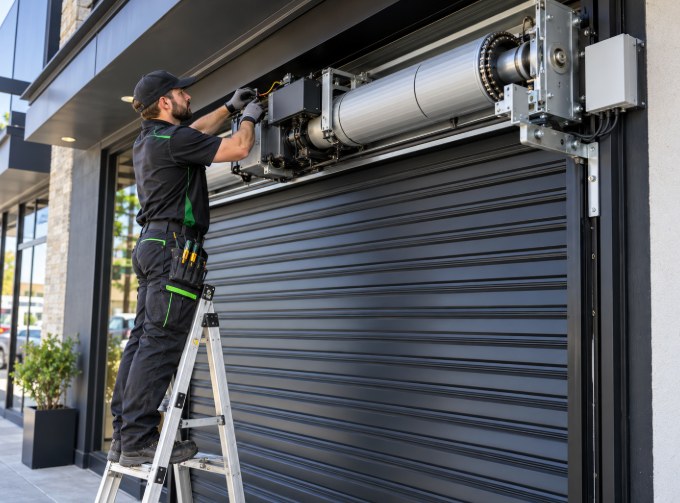
Technician on a ladder installing a rolling gate opener motor above a storefront
  • Serving Brooklyn since 2012
  • Bonded and insured
  • Motors, remotes and automation
  • Brooklyn and all of NYC

However, choosing an opener requires more than finding a motor with sufficient power. The complete system must be compatible with the curtain, drive mechanism, barrel, counterbalance arrangement, electrical supply, and expected operating conditions.

Our rolling gate opener services cover new operator installation, existing equipment repair, motor replacement, control troubleshooting, and upgrades from manual to motorized operation where appropriate.

The purpose of a properly selected opener is to provide dependable operation within the equipment's specified limits while maintaining all required safety functions.

Opener and Motor Services

Installation, diagnosis, programming and upgrades for powered rolling gates.

Rolling Gate Opener Installation

Installing an opener begins with assessing the mechanical condition of the rolling gate. The curtain must travel correctly, the supporting components must be suitable, and the proposed motor must be compatible with the gate's construction. A technician should review available mounting space, electrical supply, operating frequency, and the manufacturer's approved operator configuration.

Installation can include the operator, transmission or drive components, controls, and appropriate protective accessories. After installation, the system should be tested through its intended operating range.
Rolling Gate Motor Repair

Motor failures may involve electrical faults, internal operator damage, defective controls, or mechanical resistance elsewhere in the assembly. A gate that stops halfway may not necessarily have a damaged motor. An obstruction, faulty sensor, counterbalance issue, or problem with the drive system can produce similar symptoms. Professional diagnosis should establish the cause before parts are replaced.

Rolling Gate Motor Replacement

Motor replacement may be appropriate when the operator is extensively damaged, obsolete, or unsuitable for the property's operating needs. The replacement must be selected according to the required load, operating characteristics, compatible controls, and manufacturer's specifications. A more powerful operator is not automatically a better choice. Improper equipment selection can create excessive forces or mechanical problems.

Automatic Rolling Gate Conversion

Some manual rolling gates can be upgraded to powered operation. However, the existing curtain and mechanical system must first be evaluated. Important considerations include curtain weight, counterbalance condition, structural support, available operator space, and compatibility with required protective equipment.

An older or severely damaged manual gate may require substantial repairs or replacement before automation is appropriate.

Rolling Gate Remote Control Programming

Compatible remote controls can provide convenient operation from an authorized location. Programming may involve adding new transmitters, replacing damaged remotes, or removing missing devices from the system's authorized controls. Compatibility depends on the operator and receiver.

Not every universal remote will communicate with every rolling gate operator. The intended method of remote operation must also be appropriate for the installed safety system.

Rolling Gate Key Switch Installation

Key switches allow authorized users to operate certain rolling gates. They are commonly considered for storefronts and commercial entrances where access should be controlled. Installation should account for switch placement, accessibility, visibility of the gate, and the permitted operating mode.

A key switch should not encourage users to operate equipment while standing in a hazardous location.

Rolling Gate Control Board Repair

Control boards coordinate electrical commands and functions within certain powered systems. A defective board may cause intermittent operation, failed responses, or incorrect stopping behavior. Similar symptoms may also result from damaged wiring, controls, sensors, or power supply problems.

Diagnosis should determine whether the board itself is faulty before replacement. Any repair must preserve the manufacturer's approved protective functions.

Rolling Gate Limit Switch Adjustment

Travel limits control where the powered curtain stops during opening and closing. Incorrect settings may cause the gate to stop prematurely or attempt to travel too far. Limit adjustment should be performed according to the specific manufacturer's instructions. After correction, the system must be tested for proper stopping behavior.

Rolling Gate Safety Sensor Repair

Some powered rolling gates use photoelectric sensors, sensing edges, or other approved entrapment-protection devices. These are intended to identify specified hazardous conditions during movement. Their selection and configuration depend on the operator and installation.

Safety devices must be compatible with the equipment and maintained according to manufacturer instructions. UL 325 covers electric operators and associated protective equipment, while UL 294 concerns access-control system units.

Rolling Gate Emergency Operation

Certain motor-operated rolling gates include manual operating arrangements for power failures or service conditions. These may involve a chain hoist, release arrangement, or other manufacturer-approved mechanism. Not every system provides the same emergency operation method.

Users should follow the product's instructions and avoid activating a manual release when the gate is damaged, unstable, or improperly balanced.

Rolling Gate Access Control Integration

Compatible operators may be integrated with selected access-control equipment. Examples include authorized key switches, keypad systems, credential readers, and building-management controls. The system should be designed so that convenient access does not interfere with required protective functions. Remote or unattended operation requires particular attention to the manufacturer's permitted control modes.

Rolling Gate Opener Troubleshooting

Common opener symptoms and what usually causes them. A technician should confirm the cause before parts are replaced.

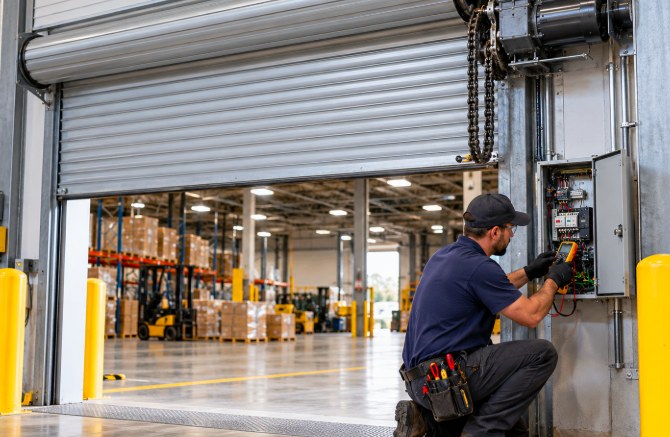
Technician testing the control panel of a warehouse rolling door operator with a multimeter

Motor does not respond

Electrical supply, controls, operator fault

Gate stops during travel

Obstruction, limits, overload, safety device

Remote does not work

Battery, programming, receiver fault

Motor makes abnormal noise

Internal wear or drive-system issues

Gate closes incompletely

Travel limits, obstruction, mechanical problem

Motor runs but curtain does not move

Drive disconnection or mechanical failure

Our Opener Installation Process

Six steps to safe, dependable automatic operation.

  1. Gate assessment

    We check that curtain travel, counterbalance and structure suit powered operation.

  2. Operator selection

    An operator is matched to the load, duty cycle, drive arrangement and manufacturer specifications.

  3. Electrical planning

    We confirm the power supply, disconnect, wiring route and control locations.

  4. Installation

    The operator, drive components, controls and protective devices are mounted and connected.

  5. Limits and safety setup

    Travel limits and required safety functions are configured to the manufacturer instructions.

  6. Testing and handover

    We test full operation and show you the controls and emergency operation.

Rolling Gate Opener Cost

Opener pricing depends on the gate, the operator and the controls you need.

Opener installation

A new operator for a compatible rolling gate, with controls and required safety devices.

$500 - $1,200Typical starting range

Adjustments and minor repairs

Remote programming, limit adjustment and minor fixes.

$150 - $350

Manual to automatic conversion

The existing gate must be evaluated before automation.

Quoted after evaluation

What affects the price

  • Curtain size and weight
  • Operator type and duty cycle
  • Electrical supply and wiring
  • Controls: remotes, key switches, keypads or access control
  • Required safety devices
  • Condition of the gate and counterbalance

Prices are typical starting ranges for Brooklyn and NYC projects. Your final price is confirmed after an on-site assessment, and you receive a clear quote before any work begins. Free estimates are available for installations and larger repair projects.

Rolling Gate Opener FAQs

Possibly. A technician must evaluate the existing door assembly and verify compatibility with an approved operator.

Possible reasons include mechanical resistance, operator limits, electrical faults, overload, or activation of protective devices.

Certain compatible systems support connected access controls. The installation must still satisfy the permitted operating and safety requirements.

That depends on the fault, equipment age, available components, and compatibility with the existing gate.

The required protective measures depend on the equipment classification, operating mode, applicable standards, and manufacturer instructions.

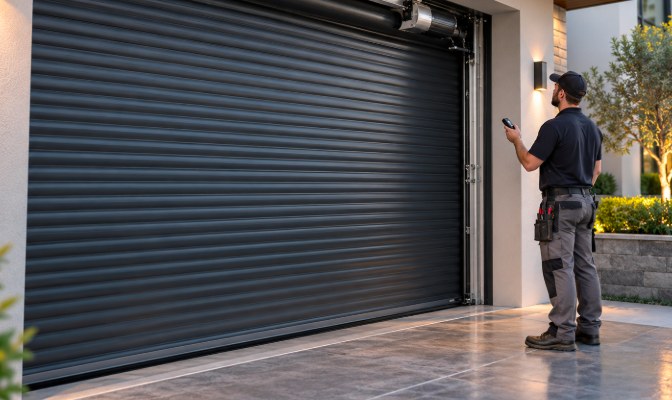
Technician testing a remote control on a dark residential rolling gate

Request Rolling Gate Opener Service

Upgrade your rolling gate with an operator that matches its mechanical construction and operating needs. Contact our team for motor installation, operator repair, replacement, or automation evaluations.